

Monday, February 9, 2026
Bespoke Software
When the tailor charges the same as the department store.
A bespoke suit isn't about showing off. It's about the absence of compromise. The fabric is chosen for you. The cut matches your body. You don't adapt to the suit — the suit adapts to you.
That same idea is starting to apply to software.
For decades, we've all been wearing off-the-rack. The same project management tools, the same CRMs, the same note-taking apps — all designed for millions of people, which means they were designed for nobody in particular. We adapted our workflows to the tool. We learned the tool's mental model instead of building one that matched our own.
That was a reasonable trade-off when custom software cost six figures and took months. It's a much harder trade-off to justify now.
The Off-the-Rack Trade-Offs
Mass-market software serves millions of users. That's impressive engineering, but it comes with unavoidable compromises:
Usability for the average. Interfaces get designed for the broadest possible audience. Features accumulate because every user needs something different. The result is an app with a hundred capabilities, twelve of which you actually use, arranged in a way that matches nobody's actual workflow.
Attention as the business model. Notifications, streaks, gamification, infinite scroll — mass-market apps need your engagement to survive. They're not optimized for your productivity. They're optimized for your time on screen.
Data collection as subsidy. Free and cheap software has to make money somehow. Usually that means harvesting your data, showing you ads, or locking you into an ecosystem that makes leaving painful. The product is affordable because you're paying in ways that don't show up on an invoice.
Feature bloat as strategy. Every feature serves somebody, so nothing gets removed. The product grows until it serves everyone adequately and no one well. Your daily driver has capabilities designed for use cases you'll never encounter, adding complexity to every interaction.
None of these are malicious decisions. They're rational responses to the economics of building software for millions. But they are compromises — and until recently, there was no alternative.
What Bespoke Looks Like
Imagine software built the way a tailor builds a suit. Measured to fit. Nothing extra, nothing missing.
Your workflow, not theirs. A task manager that matches exactly how you organize work. A dashboard that shows the data you care about, arranged the way your brain expects it. No onboarding needed because the tool was built around your existing mental model.
No dark patterns. Your tool doesn't need to fight for your attention. It doesn't need engagement metrics or retention features. It just needs to work, then get out of the way. Software that respects your time because it has no incentive not to.
Privacy by architecture. When you're the only user, there's no data to harvest. Local-first, on your device, under your control. Not because of a privacy policy — because of how the thing is built from the ground up.
Exactly the right complexity. Not dumbed down for beginners, not bloated for power users you'll never be. The exact feature set you need, at the exact level of depth you want. Nothing to configure away. Nothing to unlock.
Why This Is Possible Now
Custom software used to mean hiring a development team. $150K+ per year. Months of requirements gathering. Enterprise-grade budgets for individual-grade problems.
The economics didn't work for individuals. Only large organizations could justify the cost.
AI changed the math. A tool that would have taken a team months can now be built in days at a fraction of the cost. The development cost dropped far enough that commissioning a custom app is now closer to commissioning a custom suit than commissioning a building.
This isn't theoretical. I build bespoke tools for myself constantly — workout trackers, content pipelines, financial dashboards — each one shaped to exactly how I think about the problem. None of them would make sense as products for millions of people. All of them make my work better because they fit.
The Investment Mindset
The luxury goods parallel isn't just a metaphor. It's a useful way to think about the economics:
One-time investment, lasting value. A bespoke suit lasts decades. Custom software doesn't have a monthly subscription ticking away. You own it. The value doesn't expire when you stop paying.
Maintenance is minimal. Software that serves one person doesn't need constant updates for cross-browser compatibility, security patches for millions of attack vectors, or feature releases to retain subscribers. It just needs to keep doing what it does.
It compounds with use. The more you use bespoke software, the more you can refine it. Small adjustments accumulate into something that feels like an extension of how you think. This is the compounding loop applied to your personal tools.
The value is in the fit, not the features. Nobody sees your custom time-tracking app. There's no status in it. The value is entirely in the daily experience of using a tool that works exactly the way your brain works — no friction, no workarounds, no adapting yourself to someone else's design decisions.
Where This Goes
We're at the beginning of a shift from software-as-product to software-as-craft. The same way bespoke tailoring moved from royalty to anyone who values the fit, bespoke software is becoming accessible to anyone with a clear idea of how they want to work.
The interesting question isn't whether people will commission custom software. It's what happens to mass-market tools when they can. When the alternative to adapting yourself to an app is having an app built around you — and the cost difference is a few hundred dollars instead of a few hundred thousand — the trade-offs that seemed reasonable start looking like unnecessary compromises.
Software that fits. That's what's becoming possible. And once you've experienced it, off-the-rack feels like a choice you no longer have to make.
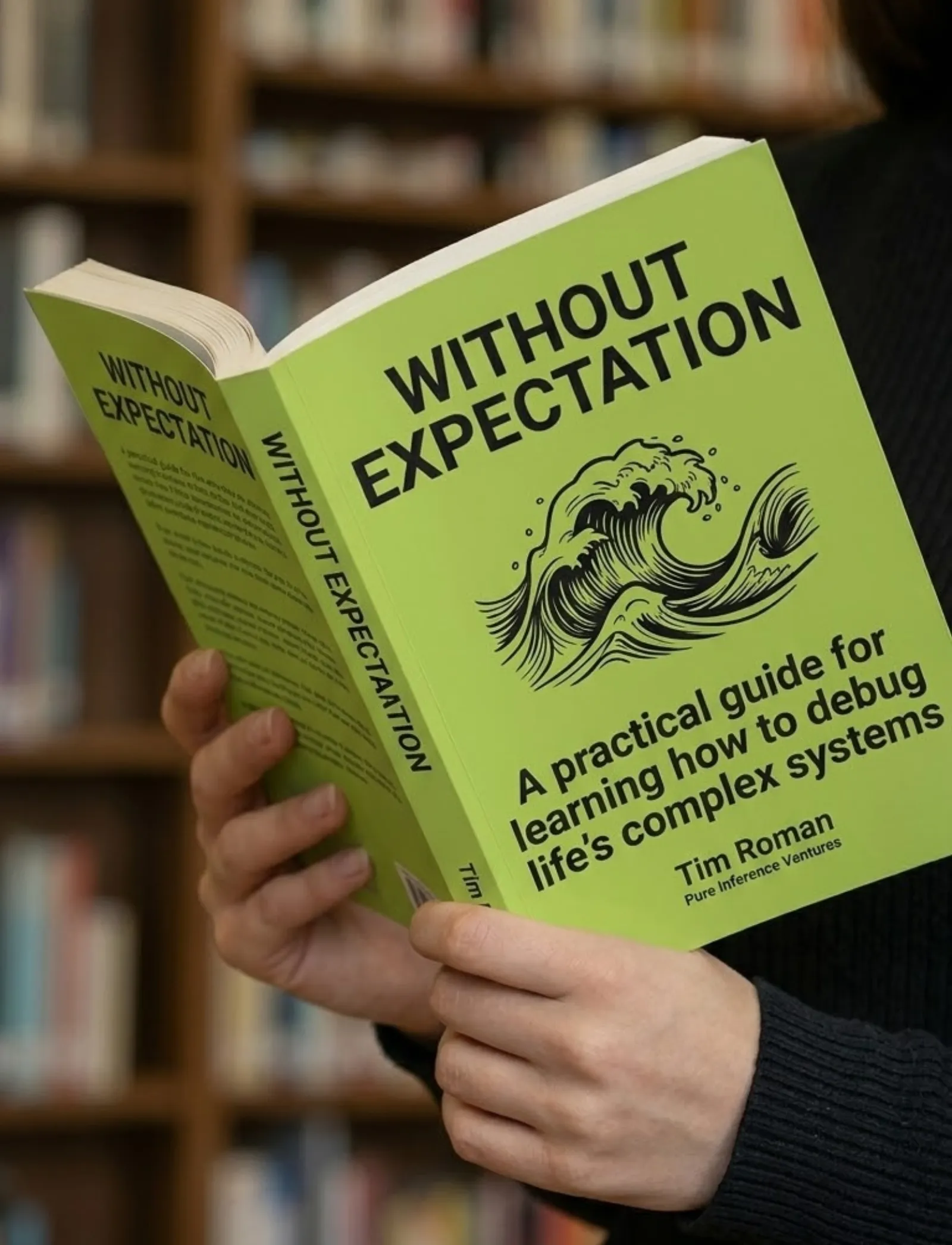
Book & App — Launching September 2026
Without Expectation
Debugging Life's Complex Systems
The same systematic approach engineers use to debug complex systems — applied to the complex system of your life. Learn to observe without judgment, distinguish symptoms from root causes, and run small experiments that compound into massive change.
- 23 chapters
- AI prompt templates
- iOS companion app
- Print, digital & audio
If you liked this, you might also like...

Bigger Than the Internet
The internet connected what existed. This creates what doesn't. That's why software's moment isn't like YouTube or podcasts — it's the long tail of creation finally becoming economically viable.

Why I Built My Own Accounting Software
QuickBooks is designed for millions of businesses. Mine has one user, one company, and an AI operator who reads every transaction. That changes everything about how accounting software should work.