

Wednesday, January 28, 2026
The 100x Solo Operator
AI as every department. One person at the helm.
I have a marketing team, an engineering team, and a research department. Operations, design, finance — all covered. They're available around the clock, context-switch instantly between projects, and never push back on scope changes.
I'm the only employee.
The 100x developer is a meme — a shorthand for exceptional programmers that's been debated and debunked for decades. The 100x solo operator is something different. It's not about being a hundred times better than your peers. It's about building systems where AI handles execution across every business function while you handle the one thing it can't: deciding what matters.
This is now a legitimate way to run a company. Not a proof of concept. Not a stunt. A sustainable operating model that changes the math on what one person can build.
Manager of Infinite Minds
Satya Nadella put it well at Davos: "The one I like as a metaphor is a manager of infinite minds. When you look at all the agents you are working with, you need to understand... we macro delegate and micro steer."
That framing matters. You're not doing every job yourself. You're not even doing every job with AI assistance. You're managing AI workers who handle execution while you handle direction.
When Nadella describes his own workflow — "foreground agent, background agent, and then just literally go edit in VS Code right there, all happening in parallel" — he's describing orchestration. Multiple streams of work, managed simultaneously, converging on outcomes you couldn't achieve sequentially.
"The workstation is back," he noted. "I started my career on a command line. Who knows, I may just end it on a command line."
The interface that enables this looks more like an operations center than a productivity app. Terminal windows. Multiple agents. Parallel execution. The solo operator isn't working faster — they're working wider, across every function simultaneously.
The Team You Don't Hire
Here's the functional map of a one-person company with full-stack AI:
Marketing handles content generation, social presence, copywriting, and distribution. The AI drafts; you edit for voice and strategic fit. Campaigns that once required a team now require a workflow and good judgment about what's worth saying.
Engineering builds through Claude Code, Cursor, and AI-assisted architecture. The code gets written; your job is knowing what to build, recognizing when it's good enough, and catching the over-engineering that AI defaults to.
Research runs competitive analysis, synthesizes market signals, mines API documentation for product ideas, and turns hours of reading into actionable intelligence in minutes. The bottleneck shifts from "finding information" to "knowing what questions to ask."
Operations automates workflows, manages data pipelines, handles reporting. The infrastructure that used to require dedicated hires now requires operational thinking — understanding what should be systematized and what needs human touch.
Design works from UI kits and component libraries established upfront. Strong constraints produce consistent output. The AI executes within the system rather than reinventing one for every task.
Finance handles bookkeeping, invoicing, projections. Not glamorous, but no longer a time sink that pulls focus from higher-leverage work.
The human role across all of this? CEO. Direction, judgment, quality control. The three skills AI can't replace — aspire, judge, create — become the entire job description.
The Bottleneck Shifts Upstream
When execution becomes cheap, the constraint moves to judgment.
The hardest part of running a company with AI isn't the AI. It's knowing what to tell it to do. Every function is available, every capability is accessible, and suddenly the limiting factor is your own clarity about what actually matters.
Focus becomes the scarcest resource. The temptation is to build everything — every feature, every channel, every idea that seems viable. AI makes each one feel achievable. The discipline is choosing which to actually pursue and which to let go.
"Done" becomes genuinely difficult. When refinement is nearly free, the temptation is to polish forever. The judgment to ship something good enough — not perfect, not iterated into oblivion — requires active resistance against the ease of one more pass.
Quality control at scale is a real problem. How do you catch what you don't know to look for? The answer is verification patterns: multiple AI models providing different perspectives, test-driven development as living documentation, systematic review processes that don't depend on your expertise in every domain. You learn to watch for convergence — when three different approaches point to the same answer, you can trust it more.
This is the "macro delegate, micro steer" that Nadella described. You're not checking every line. You're building systems that surface the decisions that actually need human judgment.
The Workflow Reality
What does this actually look like in practice?
Morning: Review overnight outputs from background agents. Quick triage — what shipped, what needs attention, what failed. Respond to anything time-sensitive.
Working sessions: Foreground work on the highest-leverage problem. Claude Code in the terminal for implementation. Cursor when you need to read and understand existing code. Multiple browser tabs with documentation, competitor products, reference material. AI running research queries in parallel while you focus on the core problem.
Transitions: When context-switching, spawn a background agent to continue the previous thread. Document enough context that future-you (or future-AI) can pick it up. Never let work go cold without capturing state.
End of day: Queue up overnight work. Research that can run async. Content drafts for morning review. Builds that should run while you sleep.
The pattern is parallel execution with serial judgment. AI handles the breadth. You handle the depth on decisions that matter.
The Honest Trade-offs
This path has costs that don't show up in productivity metrics.
Loneliness is real. The human need for collaboration, for peers who understand the work, for relationships that aren't transactional — AI doesn't fill this. The solo operator needs community, advisors, people who push back and see blind spots. The AI team handles execution. Human relationships handle everything else.
Breadth has limits. You can direct functions you understand at a basic level, but genuine expertise still matters somewhere. The model works because you have depth in at least one area that anchors your judgment everywhere else. Without that anchor, you're directing work you can't actually evaluate.
The learning curve is steep. Building systems that work — not just prompts that occasionally succeed — requires iteration, failure, and accumulated understanding of what AI does well and where it falls short. The first months are slower than traditional approaches. The payoff comes later, when the systems compound.
The trap of infinite optionality. When you can build anything, deciding what to build becomes paralyzing. Clear constraints — what you will and won't do, who you serve, what success looks like — become essential. Without them, you optimize for activity instead of outcomes.
None of this negates the model. It just means the model requires more than tools. It requires judgment, self-awareness, and intentional choices about what kind of work you're building.
The Opportunity
Microsoft added $90 billion in revenue over four years with flat headcount. LinkedIn collapsed product managers, designers, and engineers into unified "full-stack builders." The structural shift is already happening at the largest scale.
But this isn't just about enterprise reorganization. It's about individual leverage.
For the first time, a single person can operate across every function that matters. Not by working harder or longer, but by building systems that multiply output while maintaining quality. The bottleneck moves from "how do I get all this done?" to "what's actually worth doing?"
The 100x solo operator isn't a productivity hack. It's an organizational model that removes the traditional constraints on what one person can build.
The team is assembled. The tools exist. The question is whether you're ready to lead them — and whether you know what's worth building.
What are you going to make?
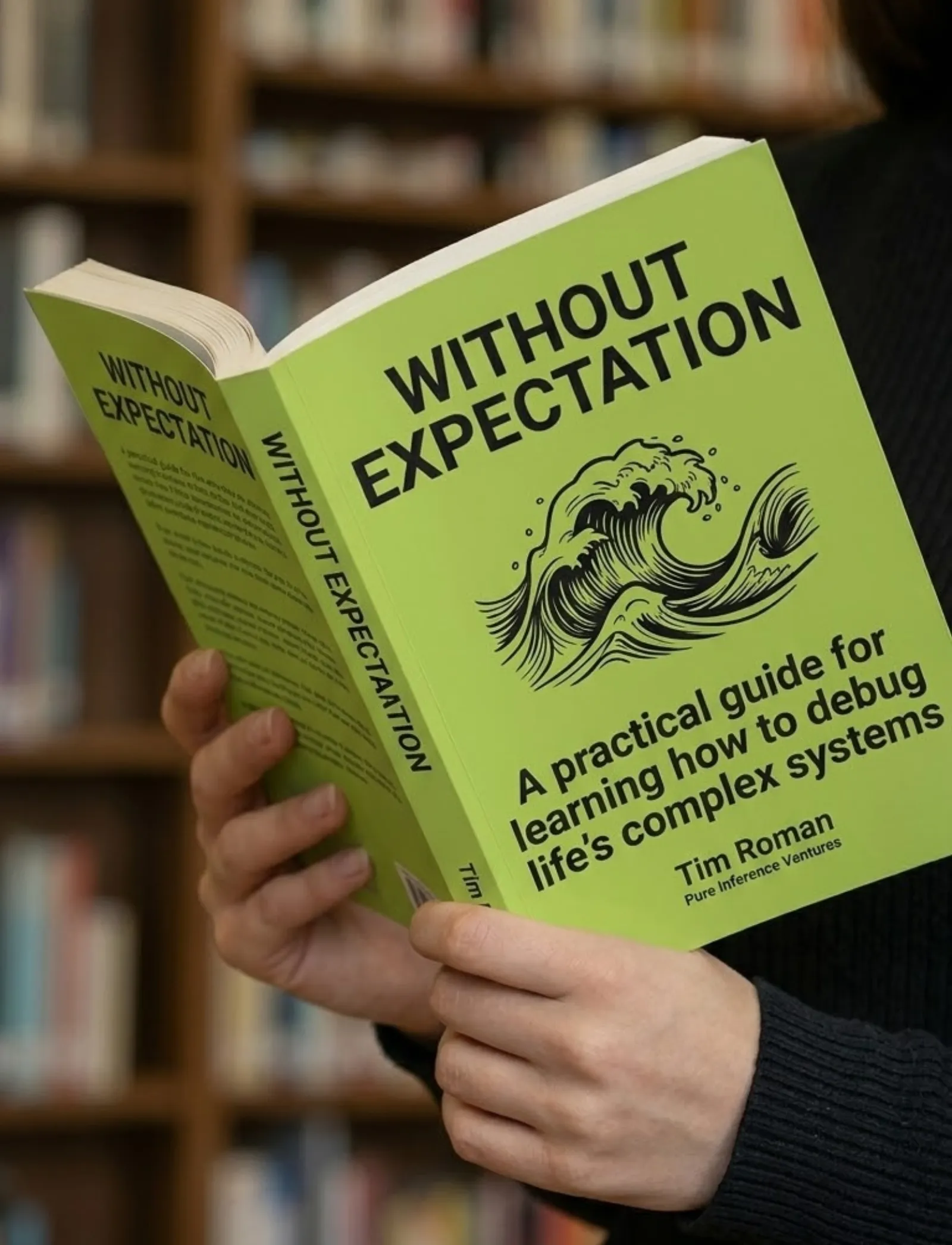
Book & App — Launching September 2026
Without Expectation
Debugging Life's Complex Systems
The same systematic approach engineers use to debug complex systems — applied to the complex system of your life. Learn to observe without judgment, distinguish symptoms from root causes, and run small experiments that compound into massive change.
- 23 chapters
- AI prompt templates
- iOS companion app
- Print, digital & audio
If you liked this, you might also like...
The Compounding Loop
We're optimizing our workflows while AI optimizes its own. The gains compound faster than anyone expected. Here's how I'm actually using this — and why the same pattern works beyond software.

Cost Per Outcome
The only AI metric that matters isn't capability — it's whether AI can produce an outcome cheaper than a human, including the cost of checking its work. And the bottleneck isn't the technology. It's our willingness to change how work gets done.