

Wednesday, January 21, 2026
Aspire, Judge, Create: The Three Skills AI Can't Replace
Build your career on what models can't do.
Most of the skills people spent decades acquiring are now automatable.
Search, synthesis, pattern matching, code generation, communication drafts, data analysis, research summaries—AI handles all of it and keeps getting better. The knowledge work that filled office buildings for fifty years is compressing into prompts.
This isn't speculation. It's happening now, faster than most people realize.
But there's a flip side that gets lost in the fear: three capabilities remain distinctly human, and they're becoming more valuable, not less.
McKinsey studied this—not from the startup hype perspective, but from enterprises asking "what can models NOT do?" Bob Sternfels, their Global Managing Partner, laid out the answer on a recent All-In Podcast episode recorded at CES 2026:
- Aspire — Set the right goals
- Judge — Apply values and context
- Create — Generate truly orthogonal ideas
Everything else is increasingly a commodity. These three are where human leverage concentrates.
Aspire: The Skill of Choosing What Matters
"Do you go to low earth orbit? Do you go to the moon? Do you go to Mars?" Sternfels asked. "That's a uniquely human capability."
Models optimize for objectives given to them. They can't decide which objective is worth pursuing. They don't have stakes in outcomes. They don't care.
Here's the uncomfortable implication: most people have spent their careers optimizing, not aspiring. Following the path. Hitting the metrics. Executing the strategy someone else set.
That was fine when execution was the bottleneck. It's not anymore.
The difference between 3% year-over-year improvement and a 50% step-change isn't better execution—it's a different aspiration entirely. Most organizations can't make that leap because they've trained their people to optimize, not to question what they're optimizing for.
Vision isn't optimization. It's choosing what to optimize for in the first place. And that choice shapes everything downstream.
Judge: The Skill of Knowing When to Trust
"There's no right and wrong in these models," Sternfels said. "How do you set the right parameters based on firm values, based on societal norms?"
AI will build something mediocre, over-engineered, or simply wrong if left unchecked. It doesn't know. It doesn't have values. It reflects training data and predicts the next most likely token.
The skill is knowing when to trust and when to push back.
The people getting burned are the ones who either trust blindly or refuse to engage at all. Both miss the point.
Effective practitioners share a common approach: they don't trust the AI, and they don't trust their own assumptions either. They ask questions. They verify—sometimes two or three times on the same work. They point the AI at different sources and watch where answers converge or diverge.
The people missing the transformation entirely are learning AI through a single lens. ChatGPT for emails. Image generators for fun. They're not in the arena. They're not seeing what's hype versus fear versus brass tacks.
You can't evaluate from the sidelines. Judgment requires being in the work.
Create: The Skill of Breaking Patterns
"True creativity," Sternfels said. "The models are inference models—the next most likely step. How do you think about orthogonal stuff?"
Here's what most people miss: complex and over-engineered is actually easier to build now. AI defaults to adding—more features, more abstraction, more edge case handling. Complexity is the path of least resistance.
Simplicity is harder. Knowing what to leave out. Knowing when "good enough" serves people better than "complete." That requires taste.
AI can generate interfaces, copy, code, and content all day. But it doesn't know what should exist that doesn't yet. It doesn't have opinions. It needs strong human direction to produce anything with genuine point of view.
Anyone can generate now. The value is in what you choose to generate, and knowing when to stop.
The Conductor Shift
Sternfels used a metaphor worth sitting with: "We need to train people to go from being part of the orchestra to everybody being the conductor, and everybody having their own orchestra of agents working for them."
This reframes everything.
The skill was never typing syntax or crunching spreadsheets or drafting memos. Those were always means to ends. The actual skill—direction, judgment, taste—just got separated from the mechanical execution that used to accompany it.
The vibecoding critics who see people generating code without "really" understanding it are missing the point. They're watching conductors and complaining they can't play the violin.
Every person is becoming a leader of machines. The question is whether they're ready to lead.
The Bigger Pivot
When the tractor was invented, farms became more automated. Farmers learned to repair tractors. Many people were freed to pursue work beyond subsistence agriculture. Society got richer.
The drywaller building homes today isn't driving every nail by hand. Tools make the work more ergonomic, safer, and four times more productive than a generation ago.
Every previous wave of tool advancement made this trade: mechanical effort got cheaper, human judgment got more valuable. This wave is no different—except the mechanical effort being automated is cognitive, not physical.
That's what makes it feel threatening. But the pattern is the same.
AI is one-on-one coaching that never gives up and never charges an hourly rate. Expertise that used to require expensive consultants or years of experience is now accessible to anyone willing to engage with it seriously.
The question isn't whether this shift is happening. It's whether you're developing the skills that remain valuable on the other side.
Aspire. Judge. Create.
Everything else, the machines are coming for.
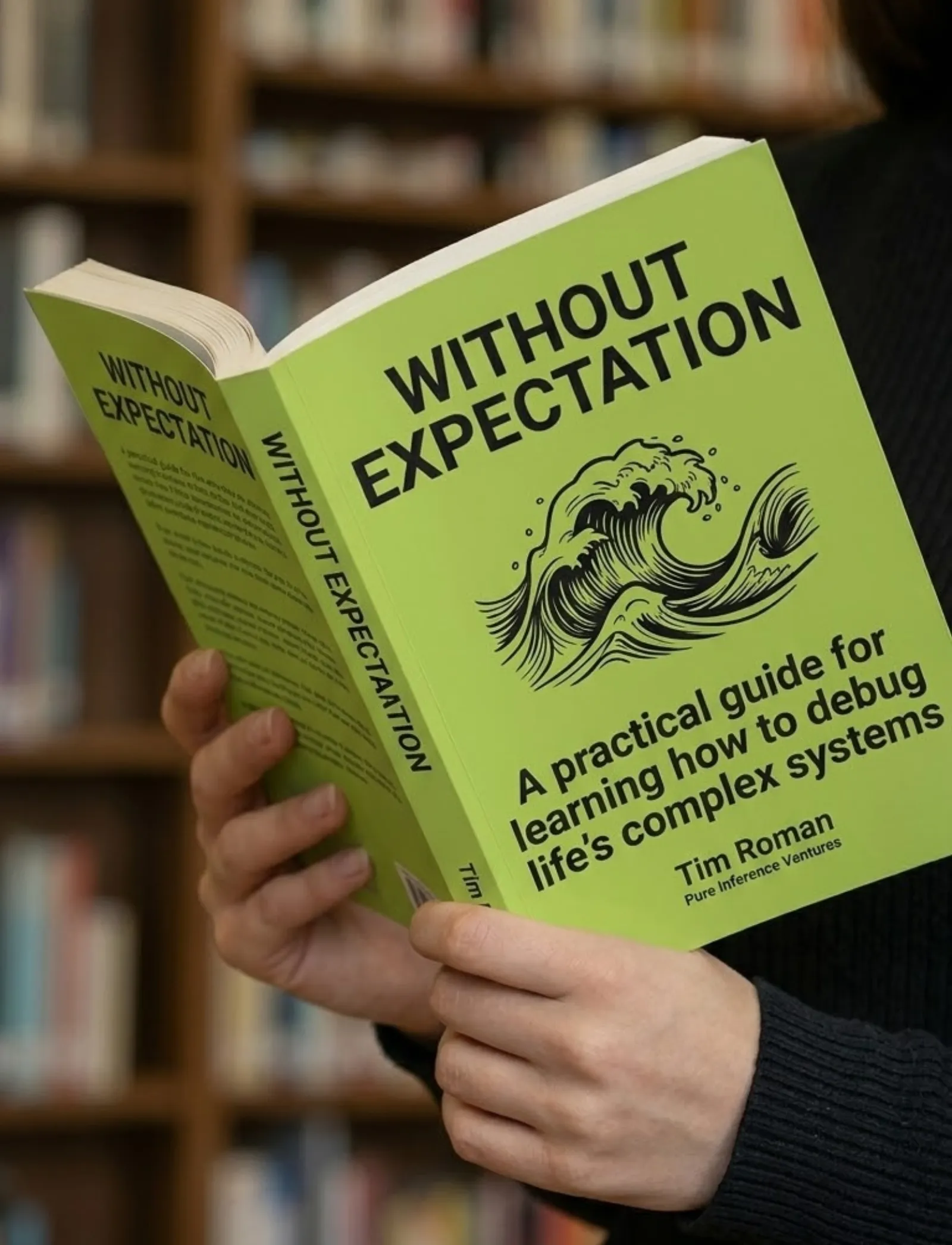
Book & App — Launching September 2026
Without Expectation
Debugging Life's Complex Systems
The same systematic approach engineers use to debug complex systems — applied to the complex system of your life. Learn to observe without judgment, distinguish symptoms from root causes, and run small experiments that compound into massive change.
- 23 chapters
- AI prompt templates
- iOS companion app
- Print, digital & audio
If you liked this, you might also like...

AI Is Teaching Me How to Be More Human
Corporate culture trained us to chase data and justify decisions. AI does that better than we ever could. What it can't do is the part that actually matters — and that realization is changing how I lead.

The Full-Stack CEO
You're not a specialist anymore. You're a CEO with digital workers in every department. The question is whether you're ready to lead them.