Book & App
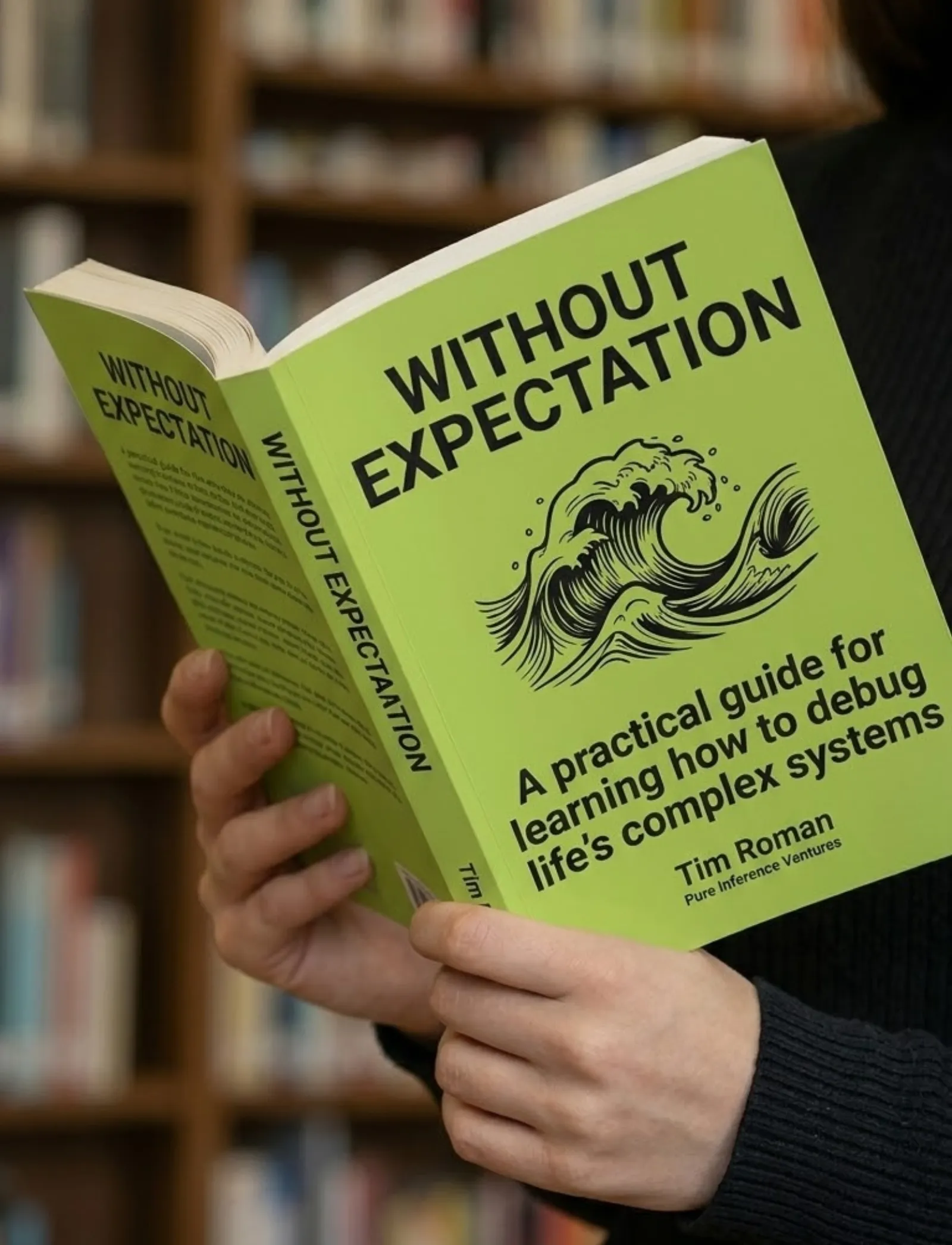
Without Expectation
Debugging Life's Complex Systems
A framework for navigating complexity—not by knowing the answers, but by learning to find them.
“It's not just for technical people. If you can ask ‘why isn't this working?’ you can debug.”
By Tim Roman · Launching September 2026 · 23 chapters · Second revision underway
More Than a Book
A framework you can actually use.
The Ecosystem
- The Book
23 chapters. The full framework.
Print, digital, and audio—launching September 2026. Covering the debugging mindset from first principles through applied practice.
- AI Prompt Templates
Bring the framework to your AI tools.
Copy-paste prompts that bring the debugging framework into ChatGPT, Claude, or any AI tool you already use. The book teaches the technique—your tools execute it.
- iOS App
Everything in one purchase.
The full book, audiobook, all prompt templates, and companion tools. Offline, in your pocket. No subscriptions. Coming soon.
- The Debug Log
Building in the open.
Weekly updates on the book's progress—what changed, what got cut, and what I learned. Follow the journey from draft to launch.
The Story
Before I learned to debug, I did what most people do with problems: I worried about them, asked friends for advice, tried whatever sounded good, and hoped for the best. Sometimes it worked. Mostly it didn't.
But it turns out there's a better way—one that engineers have used for decades to solve problems in systems far more complex than anything we face in daily life.
The better the tools get, the more the human factor matters.
What you'll learn
- •How to observe your own systems without judgment—and why that's the hardest step
- •Why accepting what is (not what should be) is the foundation of every fix
- •How small experiments compound into massive change
- •The difference between fixing symptoms and fixing root causes
- •Why the people who keep going aren't tougher—they're just better debuggers
From the Foreword
“Patient about outcomes. Urgent about action. Those sound like opposites. They're the same thing from different angles.”
What's Inside
Five parts. One process.
Part I
The Debugging Mindset
What it is, why it works, and the philosophical foundation that makes it possible.
Part II
Five Core Principles
Observe the system. Accept what is. Take small steps. Fix root causes. Keep going.
Part III
Practical Tools
Check the logs, isolate variables, get fresh perspectives, and know when to revert.
Part IV
Applied Debugging
Debugging applied to work, health, relationships, your own mind, and industries that have built their own methodologies.
Part V
The Bigger Picture
Teaching these skills to others, facing problems that can't be fixed, and building a life of continuous improvement.
Start debugging.
Visit the book site for the foreword, chapter previews, AI prompt templates, and to follow the Debug Log from draft to launch.